CogVideoX-5B
32.0%→42.0%
Joint success with a separately trained CogVideoX adapter. OMR runs at 1.67× relative time and 30.4 GB peak VRAM.
Guiding Video Generators with a Frozen World Model
Use the world-model signal before the video is finished.
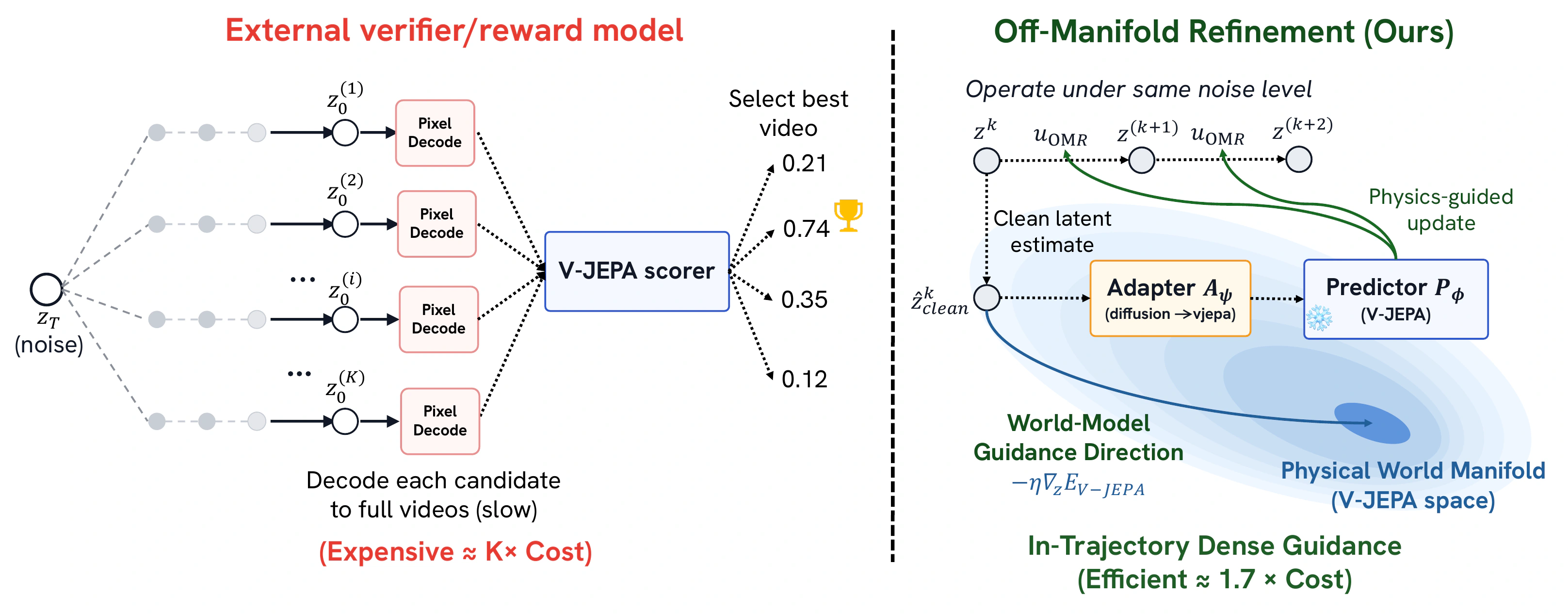
OMR uses a frozen world model to correct a frozen video generator during a single sampling trajectory. A small adapter keeps guidance in latent space—without in-loop VAE decoding or V-JEPA encoding.
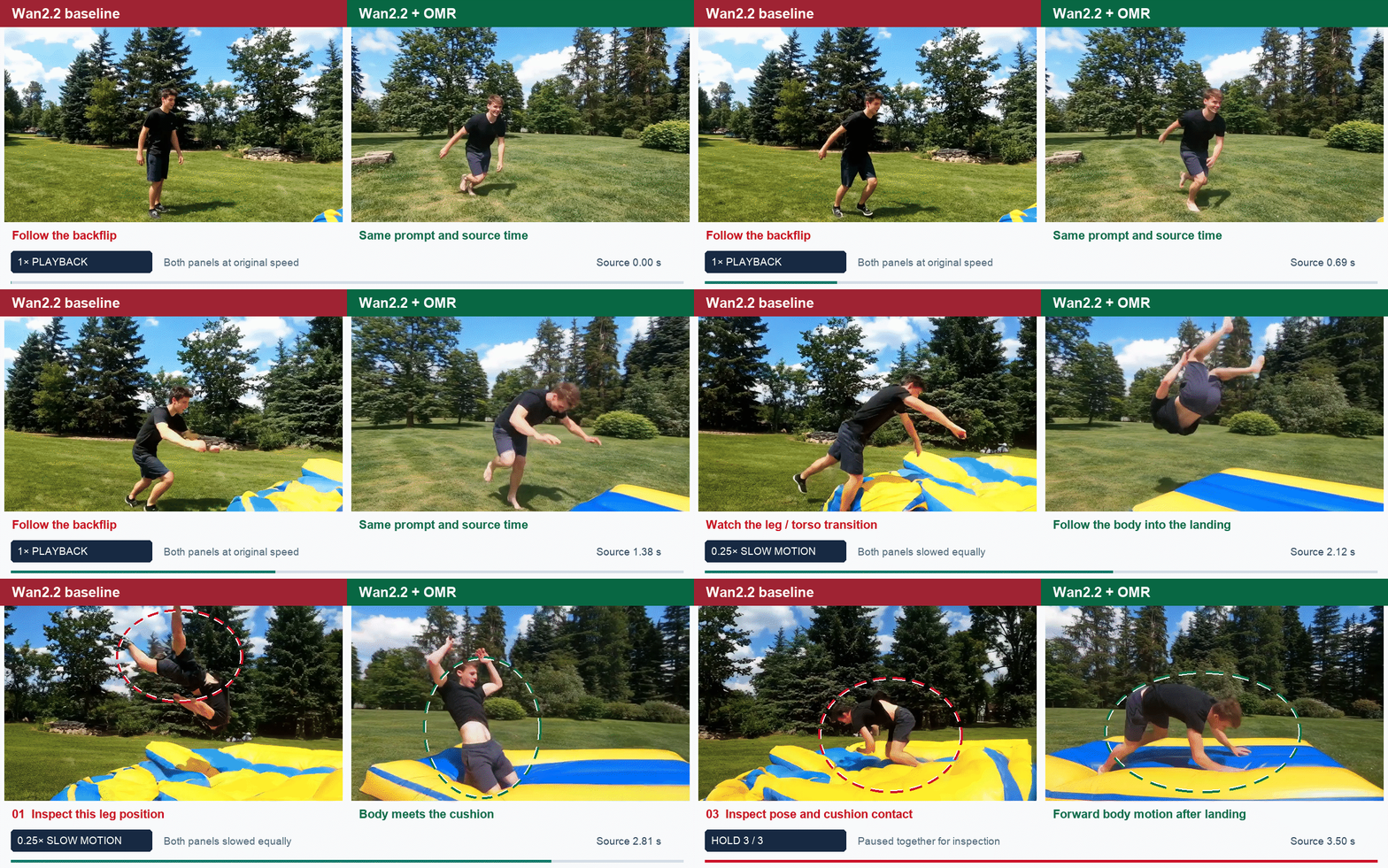
During landing, the body should move continuously and the cushion should deform under contact. Red circles mark abrupt leg–torso changes in Wan2.2; green circles follow OMR’s landing and cushion response.
Method
Video generators can produce convincing clips that violate basic cause and effect. OMR turns a frozen world model’s predictive temporal prior into a local correction, connecting the two models only through a separately trained representation adapter.
zt+Δt ← zt + Δt · uθ(zt, t) − η(t) · ∇ẑ₁ EV-JEPA(Aψ(ẑ₁))
The frozen generator supplies the ODE velocity; the frozen predictor supplies a local surprise correction through the adapter.At a guided ODE step, estimate the provisional clean video latent from the current noisy state.
Map that latent into V-JEPA feature space, mask future tokens within a 48-frame window, and compare them with the predictor’s forecast.
Backpropagate predictive surprise through the adapter and add a local correction to the sampling update.
Qualitative comparisons
Start with the annotated loops, then step through five comparisons with P&P. More baseline–OMR examples are available at the end of the page.
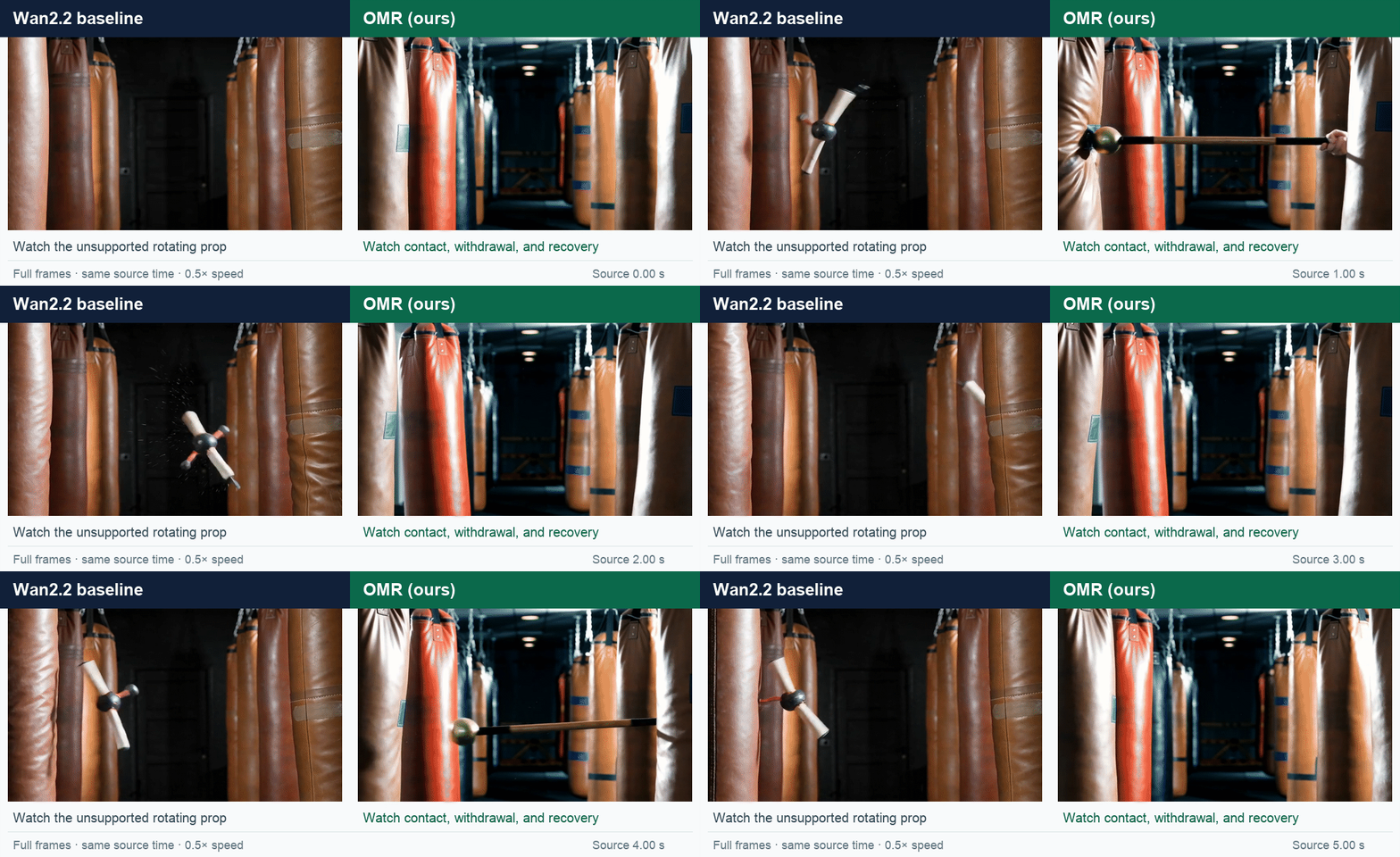
OMR shows the rod approaching, pressing into the bag, and withdrawing as the bag recovers. Wan2.2 shows a rotating prop with no visible hand support.
Both clips misrepresent the requested nunchucks. Inspect contact and recovery, not correct execution of the prompt.
Five examples · full-length comparisons
Impact and contact
Same prompt · same seed · one synchronized comparison
The wall just before the ball arrives: does the damage follow contact? Inspect 0.5–3 seconds.
In OMR, the visible wall response more closely coincides with ball contact. Compare with premature or weakly coupled damage in the baselines.
“In a dynamic sports action sequence, a baseball soars through the air, propelled by a powerful throw from an unseen player. The camera captures the ball's trajectory in a stunning close-up, revealing its textured surface and the blurred background, which hints at a bustling stadium. As the ball approaches a weathered brick wall, its speed intensifies, creating a dramatic tension. The moment of impact is captured with striking clarity, as the ball smashes into the wall, leaving a visible dent and a cloud of dust. The camera remains static, allowing the viewer to fully absorb the force of the collision and the resulting mark, a testament to the power of the throw. This cinematic moment encapsulates the raw energy and excitement of baseball, showcasing the sport's visceral impact.”
Selected qualitative comparisons, not a win-rate estimate. Inspect the remaining artifacts alongside the visible differences.
Primary results
We fixed 400 prompt IDs from the released VideoPhy-2 detailed-prompt pool before generation or scoring, and use the identical unfiltered list for every method.
| Method | SA ≥ 4 (%) | PC ≥ 4 (%) | Joint (%) |
|---|---|---|---|
| Wan2.2 | 68.0 | 57.0 | 47.00 |
| + CFG-Zero* | 68.0 | 56.0 | 48.25 |
| + P&P | 70.0 | 55.0 | 48.75 |
| + OMR (ours) | 68.0 | 60.0 | 52.00 |
One generation per prompt. SA: semantic adherence. PC: physical commonsense. Joint requires both scores to be at least 4 on the 1–5 scale.
Why it is efficient
WMReward-∇ differentiates through a V-JEPA encoder and VAE decoder. OMR instead uses the predictor and generator-specific adapter, avoiding those two additional Jacobians and their compute.
The comparison supports a more direct correction route; showing that gradients are larger or better preserved would require gradient-norm measurements.
Backward route predictor + encoder + decoder
Backward route predictor + adapter No in-loop pixel decoding
Backward gradient: OMR bypasses the in-loop VAE decoder and V-JEPA encoder.
The final output video is still decoded once after sampling.
| Method | Relative time | Peak VRAM | Joint (%) |
|---|---|---|---|
| Wan2.2 | 1.00× | 65.4 GB | 48.0 |
| + P&P | 1.6× | 72.7 GB | 50.6 |
| + BoN-2 | 2.00× | 65.4 GB | 50.4 |
| + WMReward-∇ + BoN-4 | 19.88× | 134 GB | 53.6 |
| + OMR (ours) | 1.71× | 74.1 GB | 54.0 |
Wan2.2 and OMR scores are three-seed means; the other rows are point estimates. Time is relative to the base model.
Thirteen annotators compared OMR and P&P on 100 matched prompts, yielding 1,300 judgments for this question.
Physical-plausibility preference against P&P; presentation order was randomized.
Prompt adherence: ties are the largest outcome (45.00%); P&P wins 29.92% and OMR wins 25.08%.
Transfer
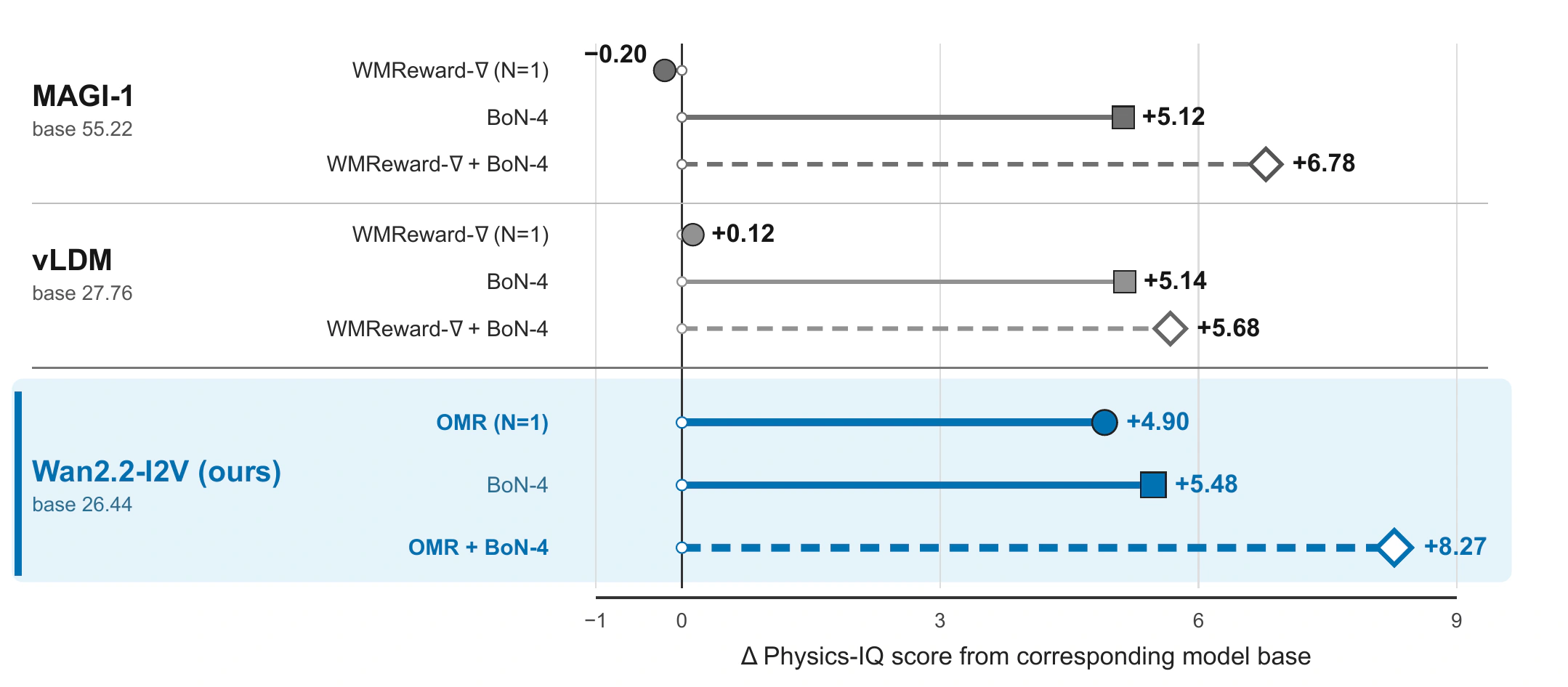
These fixed 50-prompt pilots are transfer evidence and point estimates, not full-benchmark results.
Joint success with a separately trained CogVideoX adapter. OMR runs at 1.67× relative time and 30.4 GB peak VRAM.
OMR provides a +4.90 single-trajectory gain; combining it with BoN-4 reaches 34.71 (+8.27).
Representation alignment
The generator latent and world-model target describe the same video under different objectives: one preserves content and motion for synthesis; the other preserves structure for future prediction. OMR learns a task-specific transformation between them without claiming that the two spaces are identical or globally aligned.
Training. The adapter learns V-JEPA token geometry from real-video latents.
During sampling. We test whether it preserves feature geometry and surprise rankings on provisional clean predictions—not raw noisy states—against the exact decode–encode path.
| Evaluation point | N | Token cosine | Spearman ρ | Kendall τ |
|---|---|---|---|---|
| Held-out real-video clips | 500 | 0.7506 | 0.668 | 0.477 |
| Mid-trajectory clean predictions | 200 | 0.762 | 0.617 | 0.446 |
| Matched finished controls | 50 | 0.769 | 0.624 | 0.451 |
This supports adapter use on OMR’s operating distribution. It does not prove exact adapter–encoder equivalence, raw-noise robustness, or causal attribution of the downstream gain.
Scope and outlook
OMR inherits the blind spots and data biases of its world model. It adds runtime and memory over base sampling, and each new VAE latent space currently requires adapter retraining. The transfer pilots are small and do not include paired prompt-level confidence intervals.
Can one adapter serve multiple generators? Can the guidance extend to longer videos? Larger repeated-seed studies and gradient diagnostics would help establish when and why the correction is effective.
Resources
The PDF includes the main paper and linked supplementary material.
Open PDFImplementation, configurations, prompt lists, and trained adapters will be linked here.
Coming soon@inproceedings{nguyentruong2026omr,
title = {Off-Manifold Refinement: Guiding Video Generators
with a Frozen World Model},
author = {Hai Nguyen-Truong and Tuan-Anh Vu and Dang Huynh},
booktitle = {British Machine Vision Conference},
year = {2026}
}Twelve additional examples. Choose a thumbnail to open a separate side-by-side player.
Selected examples, including close comparisons and remaining artifacts—not a win-rate estimate.